
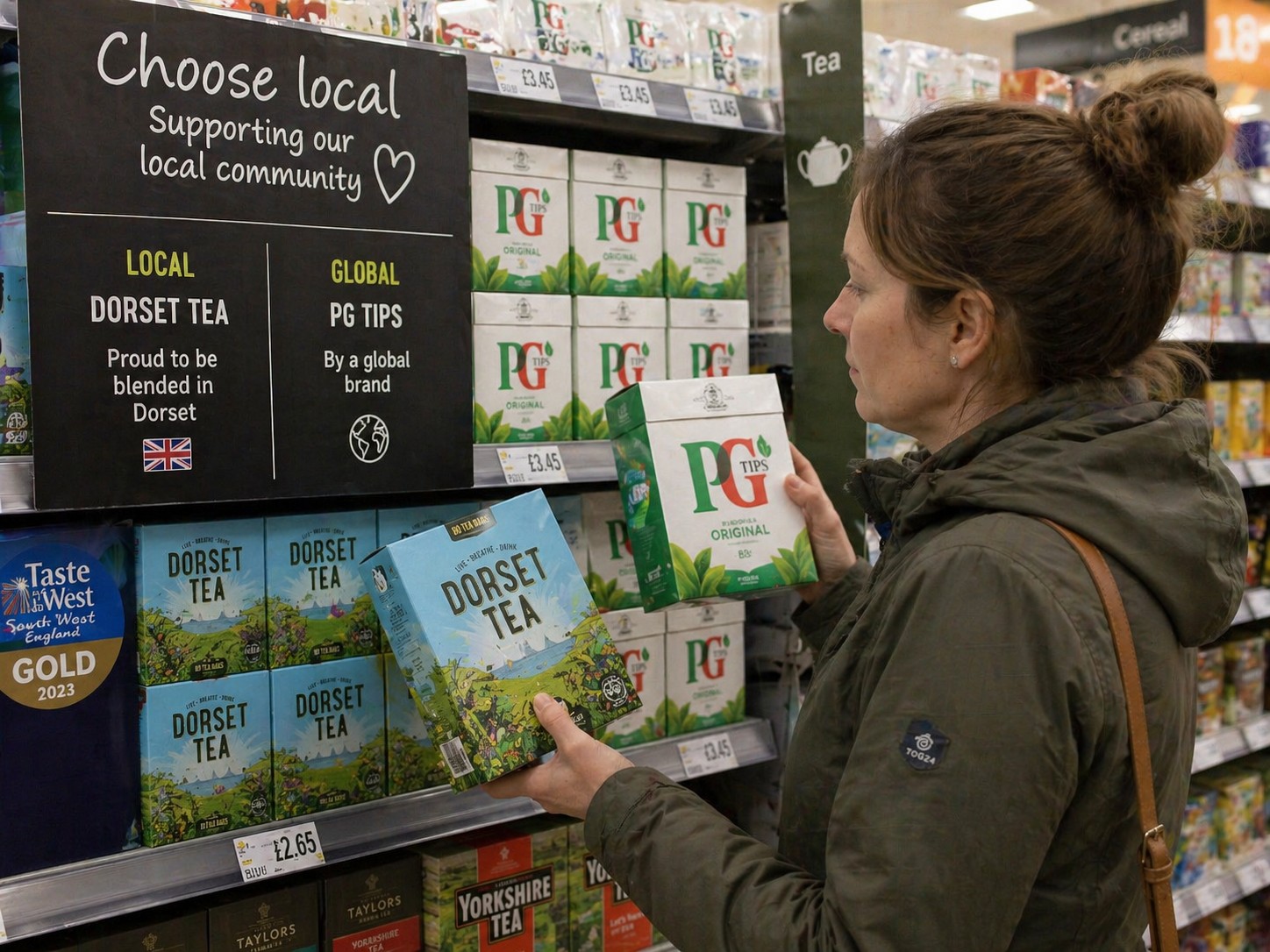
As of 2026, local and regional brands account for 66% of the products in the average shopper basket. Global brands have shrunk to 34%.
That is the line I would put on the first slide of any boardroom meeting in consumer goods this year. It is the kind of number that, once you have seen it, you cannot quite unsee. Twenty years ago, eight of the top 50 global brands by value were CPG names. By 2022, only two were left. The trajectory is not flattening.
It is tempting to read this as a story about consumer preference for local, or authentic, or sustainable. It is partly that. But the deeper read is harder for incumbents to face: the smaller players are simply running a better operating model for the way shoppers actually buy in 2026. Faster cycles, sharper personalisation, cleaner data, leaner decision rights.
This article is about what that shift really means, why scale has become a liability rather than a moat in several categories, and where Revenue Growth Management offers larger players a credible way back.
1. Why the Giants are Stalling
Most of the large CPG businesses I work with are not failing because their products are bad. Their products are usually fine. They are failing because their internal complexity has caught up with them, and the things that used to be advantages have quietly become drag.
The agility deficit
A small brand can test a new flavour, format, or claim on social media on a Tuesday and have stock on shelf within months. A major incumbent in the same category can take the better part of a year to clear the same idea through stage-gate, packaging, regulatory, and a key-account listing window. By the time the bigger player ships, the smaller one is already on its second iteration. Multiply that across a portfolio and the gap compounds quickly.
The relevance gap
In 2002, eight consumer goods manufacturers names sat in the top 50 global brands. By 2022, that had fallen to two. This is not noise. It is what happens when category leaders stop running their portfolios as collections of relevant propositions and start running them as legacy revenue lines that need to be defended.
The blind spots of scale
This one is counter-intuitive. Massive shelf presence can actively work against incumbents. A wall of near-identical packaging makes it harder, not easier, for shoppers to notice new flavours, new claims, or new formats from the same brand. The Goliath is, in a sense, hiding behind itself. Smaller brands designed for digital-first discovery and standout on a crowded shelf often get more attention with a fraction of the facings.
2. The Personalisation Penalty
Behind the agility gap sits a deeper issue, one that does not show up in headline market share until it is already too late. Today's shopper does not want a product. They want a solution that feels tailored to them.
The numbers are stark. Around 71% of consumers now expect personalised interactions from the brands they buy. Roughly 76% report feeling actively frustrated when they do not get them. Fast-growing companies derive about 40% more revenue from personalisation than their slower competitors. That is not a soft metric. It is a structural revenue gap that widens every quarter.
Personalisation has crossed the line from competitive advantage to table stakes. The brands that cannot do it are losing share to the ones that can, every week, in every basket.
This is where smaller native brands consistently outperform. They tend to lead on "better for you" positioning, on authenticity, on clear ingredient stories. They use first-party data to find what one CPG strategist I know calls the "bull's-eye consumer," the specific shopper most likely to buy, become loyal, and advocate. Larger CPGs, by contrast, are still over-reliant on broad demographic segmentation, the kind that worked when there were three TV channels and one weekly grocery shop.
3. Why "Act More Like Them" Is Harder Than It Sounds
Most senior leadership teams have already heard the diagnosis. The board response is usually some version of "we need to be more like the disruptors." The trouble is that simply telling a 5,000-person organisation to act like a 50-person one does not work. The structural barriers are real.
Decision rights are diffused across regions, categories, and functions. Approval cycles have legitimate compliance and brand-equity reasons behind them. Innovation funding is often tied to volume thresholds that small brands deliberately ignore. And critically, the data that would let a large brand personalise effectively sits in different systems, owned by different functions, with different definitions of "customer."
In short, the giants cannot beat the small brands at their own game. They have to play a different game, one that turns scale back into an advantage instead of a liability. That is what serious Revenue Growth Management actually does.
4. RGM as the Counter-Move
Revenue Growth Management has historically been positioned as a pricing discipline. In 2026 that framing is too narrow. The version of RGM that matters now is a strategic framework for using data and decision discipline to maximise profitable growth across pricing, promotions, assortment, trade terms, and mix in coordination.
Four levers do most of the heavy lifting against the small-brand threat:
- Price-Pack Architecture — Tailors range and pack sizes to specific channels and shopper missions, for example smaller formats for urban convenience and stock-up sizes for grocery, so that local buying habits are matched rather than ignored.
- Precision Promotions — Uses AI to separate promotions that drive genuine incremental volume from those that simply pull forward demand, replacing blanket discounts with targeted activity that protects margin.
- Assortment Optimisation — Strips out underperforming SKUs, the long tail of zombie products that absorb working capital, freeing space and resource for higher-growth, localised, or disruptor-style ranges.
- Personalised Pricing — Uses first-party data and loyalty integrations to deliver dynamic, individualised offers that recreate the personal touch smaller brands win on, but at the scale only larger players can afford.
Read the table as a system, not as a menu. The reason most large CPGs underperform on RGM is not that they are weak on any one lever, it is that they work them in isolation. Pricing changes happen without reference to assortment decisions. Promotions are planned without reference to pack architecture. Personalisation pilots run in marketing without ever touching the trade investment plan. The smaller brands do not have this problem because they do not have the scale to create it. The larger brands have to deliberately build the connective tissue.
5. From Scale to Precision
The longer-term move for incumbents is the one that is hardest to talk about in a board paper, because it is cultural as much as operational.
- Deploying generative AI-enhanced messaging to personalise marketing at scale, so that a global brand can speak in a recognisably local voice without rebuilding its agency model from scratch.
- Adopting agile RGM cycles, weekly or fortnightly rather than quarterly, so that pricing and promotional responses can keep pace with the actual shape of the market.
- Integrating the siloed data that already exists across sales, marketing, and finance, so that the vast resources large brands genuinely possess become a precision instrument rather than a bulky weight.
The incumbents winning in 2026 are not the ones with the biggest marketing budgets. They are the ones who have stopped pretending they can out-innovate their disruptors and started using their scale advantage in a more honest way.
6. What This Means for UK&I Manufacturers
There is an interesting twist here for the UK&I mid-market. Most Chase clients sit in the £50m to £1bn revenue band, which means in any given category they are often closer to the David than the Goliath. The lessons in this article cut both ways for them.
On one hand, the structural advantages of being smaller, faster cycles, sharper personalisation, cleaner data, are genuinely available to UK&I mid-market manufacturers in a way they are not to the global players. Many of our clients are not using those advantages anywhere near as well as they could. The point is not that they need to act like Unilever. The point is that they need to stop apologising for not being Unilever, and start using their actual size as the operational asset it is.
On the other hand, in categories where they compete against fast-moving local challengers, the Goliath problem applies in miniature. The same agility deficits, blind spots, and siloed data that hurt the global incumbents are visible in mid-market businesses too, just at a smaller scale. The diagnostic questions are the same:
- How long does it actually take us to get a new SKU from idea to shelf, and is that competitive in our category right now?
- Do we have a clear view of which shopper segments we are genuinely winning, and which we are losing share in, by retailer and channel?
- Are our pricing, promotion, and assortment decisions made in coordination, or by separate teams looking at separate dashboards?
- When did we last consciously remove a long-tail SKU because the data demanded it, rather than keep it because nobody wanted to have the listing conversation with the buyer?
The companies pulling ahead in UK&I right now, regardless of where they sit on the David-to-Goliath spectrum, are the ones that have stopped treating RGM as a pricing project and started running it as the central operating discipline of their commercial business.
Let's Talk
The shift toward smaller, sharper, more personalised brands is not going to reverse. The boards that accept that, and rebuild their operating model around it, will be the ones still relevant in 2030. The boards that wait for the trend to pass will not.
At Chase Retail & Consumer Goods we work with UK&I consumer goods leadership teams to translate exactly this kind of structural shift into specific, sequenced commercial actions: from RGM diagnostics, to assortment rationalisation, to pack-price architecture redesign, to integrated planning transformation. Every business has its own pressure points, its own legacy constraints, and its own unfair advantages to build on.
I am open to discussing further with you your specific and unique requirements. If you would like a confidential, no-obligation conversation about where the largest commercial levers are sitting in your business, and how to sequence the work, please reach out directly via LinkedIn or at Chase Retail & Consumer Goods.